PCI Bus Demystified, Second Edition

PCI-X Transactions

Comparing Conventional PCI with PCI-X

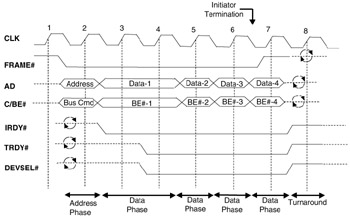
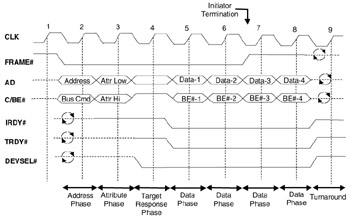
Figures 12-1 and 12-2 illustrate respectively a typical PCI write transaction and the corresponding PCI-X transaction. Let's first review the PCI write transaction.


Figure 12-1: Conventional PCI write transaction.

Figure 12-2: PCI-X write transaction.
Clock

1

The bus is idle and most signals are tri-stated. The initiator for the upcoming transaction has received GNT# and asserts FRAME#. It also places the target address on the AD bus and the bus command on the C/BE bus.

2

Address Phase. All targets detect the beginning of a transaction and sample the address on the AD bus and the command on the C/BE bus. One target recognizes that it has been selected.

3

The initiator may now place write data on the AD bus and assert the correspending byte enables on the C/BE bus along with IRDY#.

4

The target requires an extra clock to respond by asserting DEVSEL# and TRDY#. In this case both IRDY# and TRDY# remain asserted for the entire transaction resulting in four data phases in four contiguous clocks.

7

The initiator negates FRAME# signifying that this is the last data phase. The initiator must leave IRDY# asserted for at least one clock cycle beyond the negation of FRAME# to guarantee the turnaround cycle between transactions.

8

The target negates DEVSEL# and TRDY#. The initiator negates IRDY#. This is the turnaround cycle that guarantees...

UNLIMITED FREE
ACCESS
TO THE WORLD'S BEST IDEAS

SUBMIT
Already a GlobalSpec user? Log in.

This is embarrasing...

An error occurred while processing the form. Please try again in a few minutes.

Customize Your GlobalSpec Experience

Category: PCI Products
Finish!
Privacy Policy

This is embarrasing...

An error occurred while processing the form. Please try again in a few minutes.