Designing with FPGAs and CPLDs
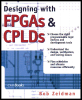
In this easy to follow guide, the author provides a look at the proprietary designs and methods of CPLDs and FPGAs available to managers, designers and engineers.
 TABLE OF CONTENTS
 This chapter describes the Universal Design Methodology for programmable devices. This method, based on my years of experience designing many types of programmable devices for small and large companies in different industries, lays out the entire process for designing a programmable device. Following the UDM guarantees that you will not overlook any steps and that you will have the best chance of creating a chip that functions correctly in your system.
In this chapter, using Universal Design Methodology as a reference model, you will learn what steps are necessary to create working, reliable chips that function correctly in your system. The first section of this chapter explains UDM and specifically UDM-PD for programmable devices. The following sections detail each step of the design process and how it relates to the method. Reading this chapter will help you:
Understand the UDM and UDM-PD methods.
Discover the importance of writing a specification and performing a specification review.
Learn how to choose appropriate programmable devices and software tools based on your specification.
Recognize the issues to consider when synthesizing your design.
Understand the need for proper simulation, review, and testing techniques during and after the process.
After years of designing circuit boards, ASICs, FPGAs, and CPLDs for a large number of companies, I noticed that engineers rarely followed a complete methodology, i.e., a complete set of standard procedures and steps. In many cases, companies simply assumed their engineers somehow knew what to do next...