Designing with FPGAs and CPLDs
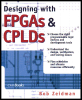
In this easy to follow guide, the author provides a look at the proprietary designs and methods of CPLDs and FPGAs available to managers, designers and engineers.
 TABLE OF CONTENTS
 In this final chapter, I discuss some of the newer architectures and technologies that are becoming available or are on the horizon. I give my opinions on which ones are interesting and which aren t, which are overhyped and which are underhyped, and which will succeed and which won t.
Understand the newer devices that are becoming available or will be available in the future.
Learn how these new technologies and design concepts relate to current designs
By a core I mean the basic functionality, excluding any extraneous circuits such as I/O buffers, that is found on a processor chip. There are two types of cores: soft cores and hard cores. The soft core, known as an IP core, is described by its logic function rather than by any physical implementation. Soft cores usually delivered to the customer as HDL code, which is then synthesized as part of the customer s design. Hard cores, on the other hand, consist of physical implementations of a function. With respect to CPLDs and FPGAs, these hard cores are known as embedded cores because they are physically embedded onto the die and surrounded by programmable logic.
Many of the FPGA and CPLD vendors have begun offering cores. As the density of programmable devices increases, these cores allow engineers to create what is called a system on a programmable chip (SOPC) using a programmable device. In other words, whereas programmable devices were initially developed to replace glue logic, engineers can now place entire systems...