Designing with FPGAs and CPLDs
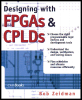
In this easy to follow guide, the author provides a look at the proprietary designs and methods of CPLDs and FPGAs available to managers, designers and engineers.
 TABLE OF CONTENTS
 | Tests for | functional problems |
| It is used | during debugging |
It is important that all state machines, and in fact all registers in your design, can be initialized. This ensures that if a problem arises, testers can put the chip into a known state from which to begin debugging.
Also, for simulation purposes, simulation software needs clocked devices to start in a known state. I like to use the example of a divide-by-two counter i.e., a flip-flop with its Qn output tied to its D input. The output of this flip-flop is a square wave that is half the frequency of the input clock signal. It may not matter in the design whether the flip-flop starts out high or low. In other words, the phase relationship between the input clock and the half-frequency output clock may not matter. But when you simulate the design, the output clock will start out undefined. On the next clock cycle, the output will change from undefined to the inverse of undefined, which is ... undefined. The output clock will remain undefined for the entire simulation.