Architectural Acoustics

Chapter 1: Basic Theory

SOUND AND VIBRATION

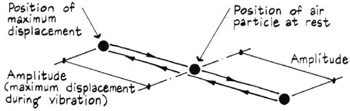
Sound is a vibration in an elastic medium such as air, water, most building materials, and the earth. [*] An elastic medium returns to its normal state after a force is removed. Pressure is a force per unit area. Sound energy progresses rapidly, producing extremely small changes in atmospheric pressure, and can travel great distances. However, each vibrating particle moves only an infinitesimal amount to either side of its normal position. It "bumps" adjacent particles and imparts most of its motion and energy to them. A full circuit by a displaced particle is called a cycle (see illustration below). The time required for one complete cycle is called the period and the number of complete cycles per second is the frequency of vibration. Consequently, the reciprocal of frequency is the period. Frequency is measured in cycles per second, the unit for which is called the hertz (abbreviated Hz).

Vibration of Particle in Air

The back and forth motion of a complete cycle is shown below.

Pure Tones

A pure tone is vibration produced at a single frequency. Shown below is the variation in pressure caused by striking a tuning fork, which produces an almost pure tone by vibrating adjacent air molecules. Symphonic music consists of numerous tones at different frequencies and pressures (e.g., a tone is composed of a fundamental frequency with multiples of the fundamental, called harmonics). To find the period corresponding to a frequency of vibration, use...

UNLIMITED FREE
ACCESS
TO THE WORLD'S BEST IDEAS

SUBMIT
Already a GlobalSpec user? Log in.

This is embarrasing...

An error occurred while processing the form. Please try again in a few minutes.

Customize Your GlobalSpec Experience

Category: Audio Transducers and Buzzers
Finish!
Privacy Policy

This is embarrasing...

An error occurred while processing the form. Please try again in a few minutes.