Architectural Acoustics

EFFECT OF STIFFNESS ON TL

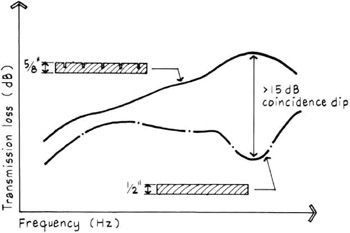
The sound isolation efficiency of materials depends on stiffness as well as mass. For example, the graph below shows TL performance for two plywood layers of equivalent total weight. According to the mass law, the TL performance should be the same. However, the grooved, less stiff layer has much higher TL performance, especially at mid- and high frequencies.

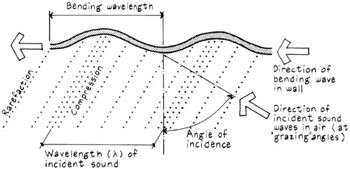
As shown by the above graph, the coincidence dip can be greater than 15 dB for stiff materials. This significant difference in TL is caused by the altered response to bending waves, which are excited by the impinging sound energy. Bending waves are similar to the wave motion in a rope shaken at one end. The exaggerated sketch below shows bending-wave coincidence for a wall.

To achieve high TL performance, use double-wall constructions with wide separation between layers, light-gauge metal studs instead of wood studs, or metal channels to "resiliently" support gypsum board layers. These elements, if properly installed, can reduce the stiffness of a barrier. The ideal sound- isolating construction would be heavy, limp, and airtight!

UNLIMITED FREE
ACCESS
TO THE WORLD'S BEST IDEAS

SUBMIT
Already a GlobalSpec user? Log in.

This is embarrasing...

An error occurred while processing the form. Please try again in a few minutes.

Customize Your GlobalSpec Experience

Category: Composite Panels
Finish!
Privacy Policy

This is embarrasing...

An error occurred while processing the form. Please try again in a few minutes.