Architectural Acoustics

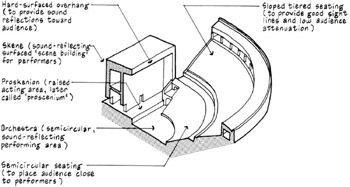
Open-air Greek and Roman theaters (constructed about 2000 years ago) most often had good listening conditions for drama and instrumental recitals by small groups. The Greek theaters usually were located on steep hillsides in quiet rural locations. Successful sites had few gusty winds (which cause noise when they blow past trees, buildings, and audience). Seating layouts were semicircular so the audience would be close to the stage, thus reducing sound energy loss by distance (see Chap. 1 for inverse-square law). The tiers were constructed with a steep rise (> 20 ) to provide good sight lines, permit reflected sound energy from the orchestra floor, and reduce attenuation caused by the seated audience. The unoccupied seats (with backs or risers sloped backward by about 10 ) and the heads of the audience also scattered sound to adjacent areas (cf., R. S. Shankland, "Acoustics of Greek Theatres," Physics Today, October 1973). In addition, actors wore masks which exaggerated their expressions and reinforced their voices since conical-shaped megaphones were built into the mouths of the masks. However, onstage whispers were not audible throughout the audience area. Some characteristic design features of ancient theaters are shown below.

Modern open-air theaters should be designed to achieve low noise intrusion (see Chap. 4) and satisfactory distribution of sound. However, an enclosure is required to achieve the reverberation and fullness of tone needed for modern symphonic music and opera (especially since the nineteenth century).
| Note | For comprehensive studies of the development of the ancient theater, see... |