Architectural Acoustics

When sound impinges on the boundary surfaces of a room, part of its energy is absorbed and transmitted, and part is reflected back into the room. Sound levels in a room can be reduced by effective use of sound-absorbing treatment, such as fibrous ceiling boards, curtains, and carpets.
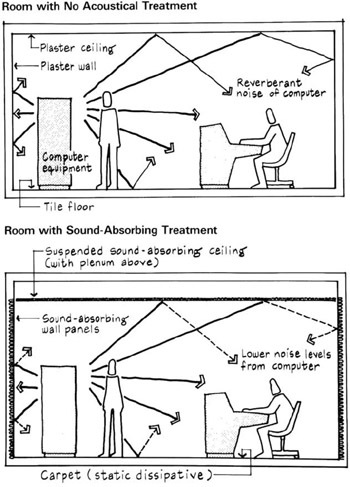
In the room with no acoustical treatment shown below, office workers hear direct sound energy from the computer equipment as well as reflected sound energy from the ceiling, floor, and walls. The computer operators, on the other hand, primarily hear direct sound from the nearest sound source, the computer. If sound-absorbing materials are added to the room, the office workers will hear considerably less sound because the reflected sound is reduced in their part of the room. The sound level near the computer equipment, however, is due mainly to direct sound and remains unchanged.

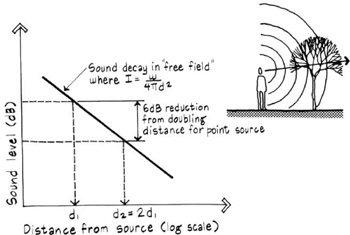
Free-field conditions occur when sound waves are free from the influence of reflective surfaces (e.g., open areas outdoors, anechoic rooms [*]). Under free-field conditions, sound energy from point sources (e.g., warning siren, truck exhaust) spreads spherically and drops off 6 dB for each doubling of distance from the source. Line sources of vehicular traffic consist of successive point sources which reinforce each other. Sound energy from line sources spreads cylindrically, not spherically, and drops off only 3 dB for each doubling of distance.

Indoors, sound energy drops off under free-field conditions...