Architectural Acoustics

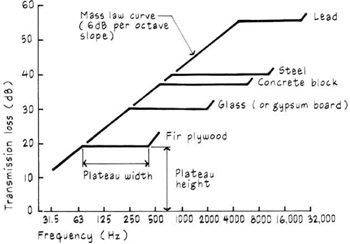
The graph below shows transmission loss performance based on equal surface weight for several materials. The curve describing TL performance for most single (or homogeneous) walls consists of three basic parts: the low-frequency mass-controlled region at about 6 dB per octave slope; the plateau region of relatively constant TL which depends on bending stiffness and internal damping of the material; and the critical frequency (and mass-controlled) region above the plateau, usually at 10 dB per octave slope. Consequently, high-frequency hissing or whistling sounds can be isolated by a material which allows low-frequency rumbling sounds to be easily transmitted.

The stiffer a wall, the lower the plateau height, meaning the poorer the sound-isolating performance. Conversely, the limper a material, the higher the plateau height and the better the sound-isolating performance. As shown by the curves, lead has the highest plateau height and the best sound-isolating performance on an equivalent weight basis. The more damping a wall has (e.g., energy loss from internal friction), the narrower the plateau width, resulting in better sound-isolating performance. Notice that plywood and lead have far narrower plateau widths than steel. When plywood is struck, it "thuds" because of its internal damping. When steel is struck, it "rings" because it has far less internal damping. For example, sheet metal air-conditioning ducts are poor isolators of sound and, as a consequence, often must be enclosed by gypsum board when they pass through noisy areas (see Chap. 5).
The TL at 500...