Architectural Acoustics

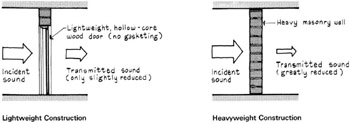
Sound waves impinging on building elements, such as walls, floor, or ceiling, produce back-and-forth motion. The magnitude of this motion or vibration depends on the weight (or mass) of the building element the greater the weight, the greater the resistance to motion and the less sound energy transmitted.

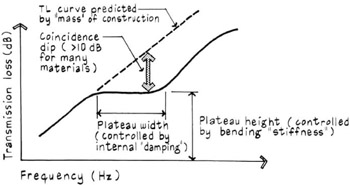
In addition to weight, other factors affect wall motion. For example, certain natural frequencies (also called "favorite frequencies") for bending waves can exist, depending on the stiffness of the construction. When these waves are excited by impinging sound energy, the resistance to sound transmission is greatly reduced (a phenomenon called the coincidence effect).

Transmission loss (abbreviated TL and measured in decibels) is a measure of how much sound energy is reduced in transmission through materials. The more massive a material, the higher its TL. However, due to coincidence effects, the TL at some frequencies will be far less than would be predicted by only considering the mass of a material. This effect is shown on the above graph of TL versus frequency.
Transmission loss can be expressed as follows:
| where TL | = sound transmission loss (dB) |
| L 1 | = sound level in laboratory source room (dB) |
| L 2 | = sound level in laboratory receiving room (dB) |
and
| where TL | = sound transmission loss (dB) |
| ? | = sound transmission coefficient (no units) |
? is the ratio of the sound energy transmitted by a material to the incident sound energy.