Architectural Acoustics

The goal of an electronic sound-reinforcing system is to provide all listeners with good hearing conditions where the unamplified sound would not be sufficient. For good speech intelligibility, the direct signal from the loudspeaker to the listener's ears must be louder than any competing sound (satisfactory signal-to-noise ratio) and be free from distortion (not "tinny" or "boomy" sound). Competing sounds include intruding noise from outdoors or within the building, mechanical system noise (see Chap. 5), noise from the audience, or reverberant sound energy. In highly reverberant rooms, the sound-reinforcing system must increase the direct sound field more than it increases the reverberant sound field. In addition, a successful system must be free from feedback ("squealing" or "howling" sound regenerated between microphones and loudspeakers) at the required operating sound level. The basic types of sound-reinforcing systems are:
Central (cluster of loudspeakers located above the actual source of sound)
Distributed (array of loudspeakers located over the listeners)
Seat-integrated (loudspeakers located in backs of seats or pews)
Combination of these systems tailored to the needs of users and natural acoustics of the room or environment
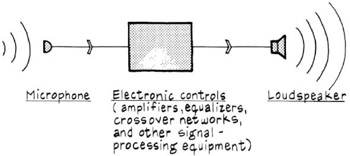
The three basic elements of a sound-reinforcing system microphones, electronic controls, and loudspeakers are shown below.

Microphones convert sound energy in air into electric energy. To avoid feedback, they normally should be located out of the loudspeaker coverage, and their frequency response should be as smooth as possible. Three common types of microphones are:
Dynamic moving coil (thin diaphragm, set into vibration...