Architectural Acoustics

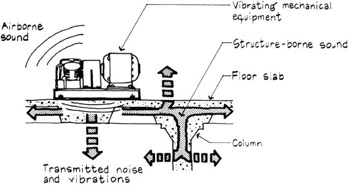
The vibrations produced from up-and-down, side-to-side, or rocking motion by mechanical equipment in buildings can be felt (< 20 Hz) and heard by building occupants. When vibrations are accompanied by noise, they tend to be more annoying. Vibrations can travel in solid building elements such as columns, beams, and floor slabs (called structure-borne sound), and may be reradiated as airborne sound great distances away from the source. Resilient mounts should be used to isolate the vibrating equipment (and anything rigidly connected to it) from the building structure. If possible, vibrating equipment should be positioned away from the center of long floor spans to locations near columns or load-bearing walls, which can provide better structural support.
The mechanical equipment shown below is bolted to the floor slab so vibrations are transmitted directly into the structure.

The mechanical equipment shown below is supported by resilient mounts (e.g., unhoused steel springs) and relocated close to the structural column. The equipment continues to be a source of airborne sound and vibrations, but the "feelable" vibrations in the structure and the structure-borne sound will be considerably reduced.

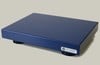
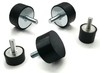
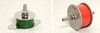
Vibration isolation involves installing vibrating equipment on resilient materials such as ribbed or waffle-shaped neoprene pads, precompressed glass-fiber pads, and steel springs. The goal is to choose an appropriate resilient material that, when loaded, will provide a system natural frequency, or resonant frequency, at least one-third of the lowest driving frequency...