Analysis of Piezoelectric Devices

Thickness modes of a plate are modes of unbounded plates. They do not depend on the in-plane coordinates of the plate and only vary along the plate thickness. Material particles in a plane parallel to the surfaces of the plate have the same motion. They are classified into thickness-shear and thickness-stretch modes, depending on whether the material particles are moving parallel to the plate surfaces or perpendicular to them. Thickness modes are the so-called high frequency modes whose frequencies are determined by the plate thickness, the smallest dimension. This is in contrast to the low frequency modes of extension and flexure in traditional structural engineering, whose frequencies depend strongly on the length and/or width of the plate. We mainly study thickness-shear modes which are the most common operating modes for piezoelectric resonators.
First we examine static thickness-shear deformations of a plate. We consider two cases of a plate under a mechanical load or an electrical load separately.
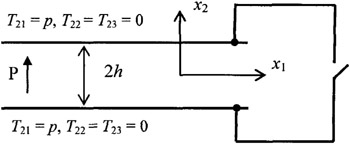
Consider an unbounded plate of crystals of monoclinic symmetry (see Fig. 2.1.1). The major surfaces of the plate are under a tangential traction p and are electroded. Two cases of shorted and open electrodes will be considered.
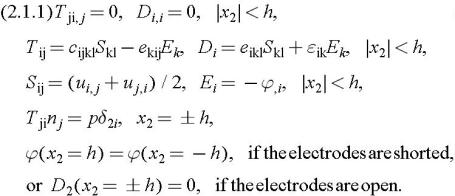
The boundary-value problem is:
Consider the possibility of the following displacement and potential fields:
From Eqs. (1.2.39) and (1.2.40), we have the following non-vanishing components of strain, electric field, stress, and electric...