Analysis of Piezoelectric Devices

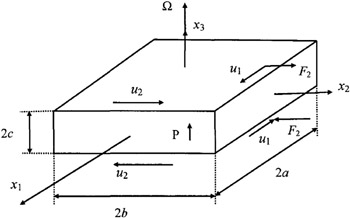
Consider a rectangular ceramic plate poled in the thickness direction as shown in Fig. 7.7.1 [84].
The plate can vibrate at the fundamental thickness-shear modes in both the x 1 and the x 2 directions. For a ceramic plate poled in the thickness direction x 3, these thickness-shear modes can be excited or detected electrically by lateral electrodes on the sides at x 1= a or x 2= b. Suppose a thickness-shear vibration u 1 in the x 1 direction is excited by a time-harmonic voltage 2 V 1exp (i ?t) applied across a pair of electrodes at x 1= a. If the plate is rotating about its normal with an angular rate ?, the Coriolis force F 2 will excite a thickness-shear motion u 2 in the x 2 direction. This secondary thickness-shear will produce a voltage 2 V 2exp (i ?t) across a pair of electrodes at x 2= b. V 2 can be shown to be proportional ? and, therefore, can be used to detect ?.
We are going to use an approximate procedure to analyze the gyroscope, which can be considered as a perturbation procedure. For the thickness-shear motion excited by V 1, the main motion is u 1( x, t