Analysis of Piezoelectric Devices

Frequency shifts in a crystal resonator due to a thin layer of mass added to part of the crystal surface is the foundation of many chemical and biological acoustic wave sensors. These sensors detect a substance through the mass-frequency effect of the substance accumulated on the crystal surface by some chemically or biologically active films. In this chapter, we analyze frequency shifts in a three-dimensional body due to a thin layer of surface mass.
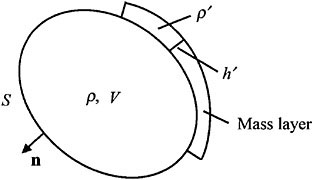
Consider a piezoelectric body with a thin mass layer of thickness h ? and density ?? on part of its surface (see Fig. 4.1.1). We study the mass-frequency effect by a perturbation method [51].
Let the region occupied by the piezoelectric body be V and its boundary surface be S. The unit outward normal of S is n. The mass layer is assumed to be very thin. For the lowest order effect of the mass layer, only the inertial effect of the layer is to be considered; its stiffness is neglected. For free vibration with a frequency ?, by Newton s second law, the traction boundary condition on the surface area with the mass layer is
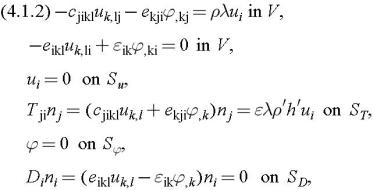
From Eqs. (1.2.16) through (1.2.21) and Eq. (4.1.1), the eigenvalue problem for the resonant frequencies and modes of the crystal with the mass layer is
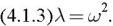
where we have denoted
In...