Temperature sensors can be designed based on frequency shifts due to a temperature change. To model temperature sensors, in this chapter we first generalize the equations of electroelasticity in the first chapter to include thermal effects. Then equations for small fields superposed on a thermal bias are presented, followed by analyses of temperature sensors.
10.1. Thermoelectroelasticity
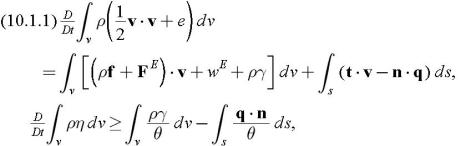
Thermal and viscous effects are treated together in this section [1, 107, 108]. The conservation of mass and the linear and angular momentum equations remain the same as in the first chapter. The energy equation including thermal effects and the second law of thermodynamics take the following form:
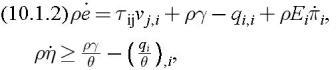
where q is the heat flux vector, ? is the entropy per unit mass, ? is the body heat source per unit mass, and ? is the absolute temperature. The above integral balance laws can be localized to yield
where ? i=P i / ?. Eliminating ? in Eq. (10.1.2), we obtain the Clausius-Duhem inequality as
A free energy ? can be introduced through the following Legendre transform:
Then the energy equation in Eq. (10.1.2) 1 and the C-D inequality in Eq. (10.1.3) become
and
Introducing the material heat flux and temperature gradient by
we write the energy equation and the C-D inequality as
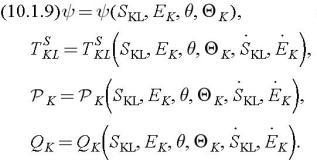
For constitutive relations we start with the following:
Substitution of Eq. (10.1.9) into the C-D inequality in Eq. (10.1.8) 2 yields
Since Eq. (10.1.10) is linear in  and
and  , for...


 TABLE OF CONTENTS