Analysis of Piezoelectric Devices

Chapter 9: Pressure Sensors

Piezoelectric pressure sensors can be made by measuring either pressure induced charge or frequency shifts. In this chapter we analyzed a few pressure sensors based on frequency shifts in resonators. References on this topic can be found in a few review articles [97 ?99].

9.1. A Rectangular Plate in a Circular Cylindrical Shell

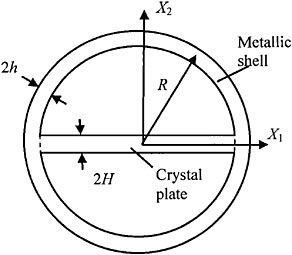
Consider a rotated Y-cut quartz thickness-shear resonator sealed in a metallic circular cylindrical shell as shown in Fig. 9.1.1 [100]. The structure is long in the X 3 direction and only a cross-section is shown. A uniform external pressure p is applied on the outer surface of the shell. The crystal plate experiences compression in the X 1 direction due to the pressure. This compression causes biasing deformations and frequency shifts in the crystal plate, which can be used to measure the pressure. The deformation is with ?/ ?X 3=0 and u 3=0.


Fig. 9.1.1: Cross-section of a crystal plate in a cylindrical shell as a pressure sensor.

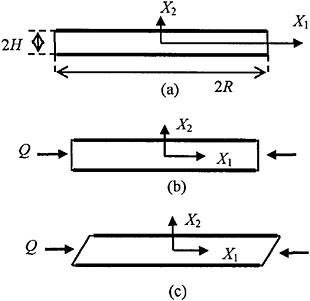
The reference configuration of the crystal plate when there is no pressure is shown in Fig. 9.1.2(a). The plate is assumed to be thin with R>>H. The pressure induces a compressional force Q on the crystal plate through the shell (see Fig. 9.1.2(b)). Q acts as biasing fields in the crystal plate. Under Q the plate vibrates at the fundamental thickness-shear mode (see Fig. 9.1.2(c)) with a frequency slightly different from the case when Q=0.


Fig.

UNLIMITED FREE
ACCESS
TO THE WORLD'S BEST IDEAS

SUBMIT
Already a GlobalSpec user? Log in.

This is embarrasing...

An error occurred while processing the form. Please try again in a few minutes.

Customize Your GlobalSpec Experience

Category: Heat Exchangers
Finish!
Privacy Policy

This is embarrasing...

An error occurred while processing the form. Please try again in a few minutes.