Analysis of Piezoelectric Devices

In this chapter we analyze piezoelectric gyroscopes that detect angular rate by charge, current or voltage. Such a gyroscope makes use of two vibration modes of a piezoelectric body. The two modes have material particles moving in perpendicular directions so that they are coupled by the Coriolis force when the gyroscope is rotating. Furthermore, the frequencies of the two modes are close and tunable so that the gyroscope operates at the so-called double resonant condition with high sensitivity. When the gyroscope is excited into mechanical vibration by an applied alternating electric voltage in one of the two modes (the primary mode) and is attached to a body rotating with angular rate ?, the Coriolis force excites the other mode (the secondary mode) through which ? can be detected from electrical signals (voltage or current) accompanying the secondary mode. Double resonance occurs when the driving frequency, the frequency of the primary mode, and the frequency of the secondary mode are all about the same.
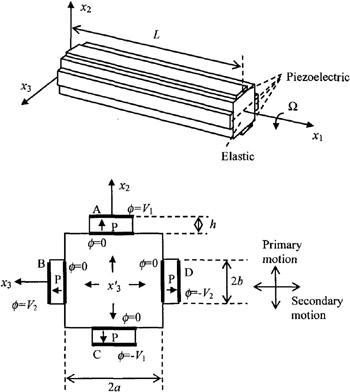
A rectangular elastic beam with piezoelectric films in flexural vibration was one of the earliest gyroscopes [70]. In this section we present an analysis on this gyroscope [78]. The structure of the beam gyroscope is shown in Fig. 7.1.1.
The elastic beam has a length L and a square cross section of equal sides 2 a. We consider a long and thin beam with L>>a. A cross...