Analysis of Piezoelectric Devices

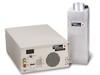
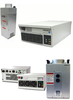
The beam gyroscope in the previous section has piezoelectric films on an elastic beam. In fact, piezoelectric materials alone can be used to make gyroscopes. Consider a long and thin circular tube of ceramics poled in the radial direction (see Fig. 7.2.1(a)) [79]. By long and thin we mean L>>R>>h, where L is the length, R is the mean radius, and h is the thickness of the tube. A cross section of the tube and the electrode configuration are shown in Fig. 1(b).
The electrodes are shown by the thick lines and they run along the entire length of the tube. The inner surface of the tube is completely electroded and is grounded as a reference. The outer surface is electroded at four locations A, B, C, and D. When an alternating driving input voltage V 1 is applied at electrodes A and C respectively, the material under A contracts and that under C expands or vice versa, thereby, exciting the tube into a flexural vibration in the x 2 direction (the primary motion). If the tube is rotating about the x 1-axis with a constant angular velocity ? which is the quantity to be measured, the Coriolis force which is perpendicular to the directions of the excited primary motion (the x 2 direction) and the angular velocity vector (the x 1 direction) causes a flexural...