Analysis of Piezoelectric Devices

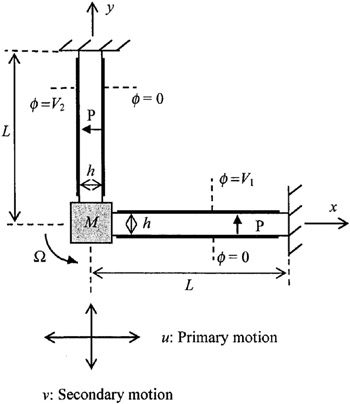
In this section we study probably the simplest gyroscope [83, 10]. Consider a concentrated mass M connected to two thin rods of polarized ceramics as shown in Fig. 7.6.1.
The two rods are electroded at the side surfaces, with electrodes shown by the thick lines. Under a time-harmonic driving voltage V 1 (t), the rod along the x direction is driven into extensional vibrations. If the entire system is rotating about the normal of the (x, y) plane at an angular rate ?, it results in a voltage output V 2 (t) across the width of the rod along the y direction. V 2 (t) is proportional to ? when ? is small, which can be used to detect ?.
For long and thin rods (L>>h) the flexural rigidity is very small. The rods do not resist bending but can still provide extensional forces. When the mass of M is much larger than that of the rods, the inertial effect of the rods can be discounted. Then the mechanical behavior of the rods is effectively like two elastic springs with the addition of piezoelectric couplings. Let the displacements of M in the x and y directions be u(t) and v(t). For each rod we also associate a local coordinate system with the x 1 axis...