Analysis of Piezoelectric Devices

7.5. A Ceramic Ring

7.5. A Ceramic Ring

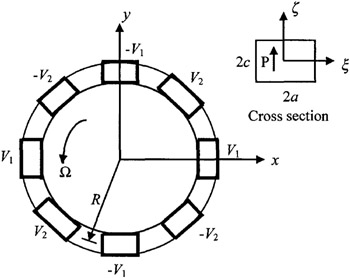
In this section we analyze vibrations of a rotating ceramic ring poled in the z direction as shown in Fig. 7.5.1 [82].


Fig. 7.5.1: A ceramic ring as a gyroscope.

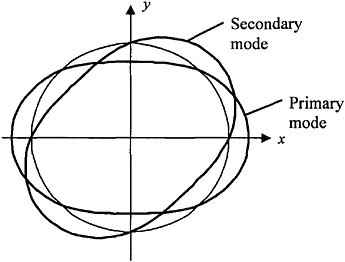
One possible arrangement of eight pairs of identical electrodes at z= c are shown in the areas bounded by the thick lines which can be used to excite and detect a particular pair of modes in Fig. 7.5.2. Equivalently, radially polarized ceramics can also be used which will require electrodes to be placed at ?= a.


Fig. 7.5.2: Radial displacements of the primary and secondary modes of a non-rotating ring.

7.5.1. Governing equations

In Fig. 7.5.1, V 1 is the input voltage across four pairs of driving electrodes and V 2 is the output voltage across the other four pairs of electrodes. We use one-dimensional equations for a piezoelectric ring [20]. The one-dimensional electric potentials are


where


and are complex constants. We have assumed harmonic time dependence and introduced the complex notation. Since the electrodes are equally spaced and that the electric potential is a constant on an electrode, the voltage distribution due to the electrode configuration in Fig. 7.5.1 is essentially piecewise constant. In Eq. (7.5.2), this piecewise constant voltage distribution is approximated by a trigonometric function. generates


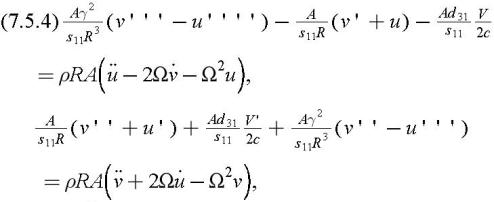
Let the radial displacement be u( ?, t) and the tangential displacement be v( ?, t). The governing equations are [82, 20]


where a prime indicates...

UNLIMITED FREE
ACCESS
TO THE WORLD'S BEST IDEAS

SUBMIT
Already a GlobalSpec user? Log in.

This is embarrasing...

An error occurred while processing the form. Please try again in a few minutes.

Customize Your GlobalSpec Experience

Category: Conductivity Electrodes
Finish!
Privacy Policy

This is embarrasing...

An error occurred while processing the form. Please try again in a few minutes.