Analysis of Piezoelectric Devices

Chapter 13: Power Transmission Through an Elastic Wall

In certain applications there are electronic devices sealed in an armor for operations in hazardous environments where physical access to the devices is prohibited. There is a need for periodically recharging the batteries inside the armor that power the devices. Piezoelectric transducers may be used to generate acoustic waves propagating through the armor for transmitting a small amount of power to the devices inside the armor. In this section we examine the performance of such a power transmission technique.

13.1. Formulation of the Problem

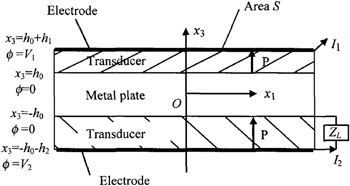
Consider the structure illustrated in Fig. 13.1.1, in which a metal plate representing the armor is sandwiched by two piezoelectric layers. These piezoelectric layers model two piezoelectric transducers, one for generating acoustic waves driven by a prescribed electric voltage source and the other for converting the acoustic energy into electric energy to power a load circuit, characterized by its impedance Z L as indicated in the figure.


Fig. 13.1.1: An elastic plate sandwiched by two piezoelectric transducers.

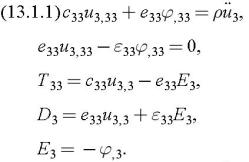
Consider thickness-stretch vibrations. For motions of the ceramic layers we have


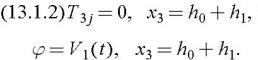
The driving transducer is electroded on its outer surface at x 3= h 0+ h 1. The electrode is subjected to a time-harmonic driving voltage V 1 (t), and the mechanical boundary condition is traction-free. These require that


The current density flowing out of the driving electrode at x 3= h 0+ h 1 is given by


where Q 1 is the charge per unit area on the electrode.

UNLIMITED FREE
ACCESS
TO THE WORLD'S BEST IDEAS

SUBMIT
Already a GlobalSpec user? Log in.

This is embarrasing...

An error occurred while processing the form. Please try again in a few minutes.

Customize Your GlobalSpec Experience

Category: Accelerometers
Finish!
Privacy Policy

This is embarrasing...

An error occurred while processing the form. Please try again in a few minutes.