Analysis of Piezoelectric Devices

Beginning from this chapter we study power handling devices. With electromechanical coupling, piezoelectric materials can be used to make generators for converting mechanical energy into electrical energy. Recently, due to the rapid development of wireless electronic devices, operating these devices without a wired power source has become an issue. One approach is to harvest power from the operating environment. Piezoelectric materials are natural candidates for scavenging ambient energy for powering small electronic devices of a very lower power requirement. Such a piezoelectric device is also called a piezoelectric power harvester.
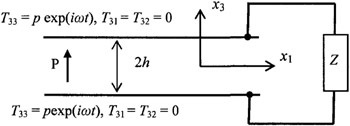
In this section we present a simple analytical solution for a piezoelectric generator operating with thickness-stretch modes of a plate from the three-dimensional equations of linear piezoelectricity [111]. Consider an unbounded ceramic plate with thickness poling as shown in Fig. 11.1.1.
The major surfaces of the plate are electroded and the electrodes are connected by a circuit whose impedance is denoted by Z when the motion is time-harmonic. When the plate is driven by a time-harmonic surface normal stress, the mechanical boundary conditions are
On each of the two electrodes, the electric potential is spatially constant, varying with time. We denote the potential difference between the two electrodes by a voltage V
The free charge per unit area on the electrode at x 3= h and the current per unit area that flows out of the electrode at x 3=