Analysis of Piezoelectric Devices

Chapter 12: Piezoelectric Transformers

Piezoelectric transformers for raising or lowering electric voltage are widely used in various electronic equipment. In a piezoelectric transformer energy converts twice: from electrical to mechanical and then back to electrical. The basic behavior of a piezoelectric transformer is governed by the linear theory of piezoelectricity.

12.1. A Thickness-Stretch Mode Plate Transformer

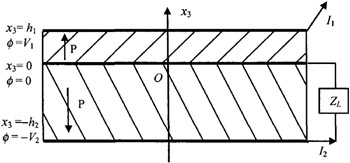
As a simple example, consider a transformer consisting of two piezoelectric ceramic plates poled in the thickness direction. It has two traction-free surfaces and an interface, which are all electroded (see Fig. 12.1.1) [116].


Fig. 12.1.1: A thickness-stretch mode transformer.

12.1.1. Governing equations

The driving portion 0 ? x 3 ? h 1 is poled in the positive x 3 direction and the receiving portion ?h 2 ? x 3 ?0 is poled in the negative x 3 direction. Under a time-harmonic driving voltage V 1 (t) with a proper frequency, the transformer can be driven into thickness-stretch vibration and produce an output voltage V 2 (t). The output electrodes are connected by a circuit whose impedance per unit area is denoted by Z L. Since the transformer is inhomogeneous with ceramics poled in different directions, we need to model each layer separately with interface continuity conditions. The plates are thin and edge effects are neglected.

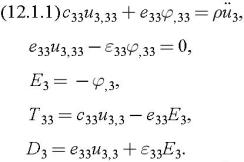
For the driving portion the governing equations for thickness-stretch vibrations are


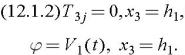
The boundary conditions at the top surface are


The current density per unit area flowing out of the driving electrode at x

UNLIMITED FREE
ACCESS
TO THE WORLD'S BEST IDEAS

SUBMIT
Already a GlobalSpec user? Log in.

This is embarrasing...

An error occurred while processing the form. Please try again in a few minutes.

Customize Your GlobalSpec Experience

Category: Board Mount Transformers
Finish!
Privacy Policy

This is embarrasing...

An error occurred while processing the form. Please try again in a few minutes.