Analysis of Piezoelectric Devices

Chapter 5: Fluid Sensors

A vibrating elastic body (resonator), put in contact with a fluid, changes its resonant frequencies. This effect has been used to make various fluid sensors for measuring fluid viscosity/density. In this chapter we discuss fluid sensors based on frequency shifts of resonators.

5.1. An Ill-Posed Problem in Elasticity for Fluid Sensors

Many fluid sensors operate with thickness-shear modes of a plate, which is a natural choice because in these modes the surface of the plate has no normal displacement so no compressional waves are generated in the fluid. The fluid produces a drag on the plate surface due to viscosity and the tangential motion of the plate surface, and thereby causes a frequency shift in the resonator. For fluid sensor applications, vibration modes of an elastic body without a normal displacement at its traction-free surface are of general interest. Vanishing normal displacement over a traction-free surface normally implies an ill-posed boundary value problem in elasticity. In this section we examine modes determined by the ill-posed free vibration eigenvalue problem of an elastic body without a normal displacement at its traction-free surface.

5.1.1. Formulation of the problem

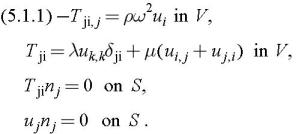
Consider an isotropic elastic body. Let the region occupied by the body be V and its traction-free boundary surface be S. The unit outward normal of S is n. For free vibrations with a frequency ?, the governing equations and boundary conditions for modes with vanishing normal displacement on S are [58]


From the theory of elasticity,...

UNLIMITED FREE
ACCESS
TO THE WORLD'S BEST IDEAS

SUBMIT
Already a GlobalSpec user? Log in.

This is embarrasing...

An error occurred while processing the form. Please try again in a few minutes.

Customize Your GlobalSpec Experience

Category: Industrial Lubricants
Finish!
Privacy Policy

This is embarrasing...

An error occurred while processing the form. Please try again in a few minutes.