Animating with Microstation
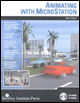
For architects and engineers who deal with 3D rendering and animations, this text covers every aspect of animating in detail, including cameras, paths, actors, motion blurs, global and source lighting, and targets.
 TABLE OF CONTENTS
 The topics covered in this chapter include:
Animation overview
Video standards
Animation tools
In this chapter you will be provided a brief overview of what animation is, as well as a brief explanation of the various types of video formats and output.
When you think of animation one of the first things that comes to mind is the Saturday morning cartoons that most of us enjoyed as kids. By drawing pictures with successive movement of objects, these animations or cartoons appear to come to life. Cartoons today are typically created on computers and some of the in between pictures (frames) can be computed rather than drawn by hand.
What all forms of cartoon animation have in common is that they create some type of perceived motion by showing successive frames at a relatively high speed. Computer cartoon animation usually shows 10 to 20 frames per second. By comparison, traditional hand-drawn animation uses anywhere from 8 frames per second (for poor-quality animation), to 12 frames per second (for standard animation), to 24 frames per second (for short bursts of smooth, realistic motion).
Human visual accuracy is limited to about 12 images per second. If you show more than 12 images per second the brain thinks it is seeing continuous motion (some people are better than others at this). If you show fewer than 12 images per second, the brain knows it is looking at single images presented rapidly. The magician relies on this fact. If they...