The Architect's Portable Handbook: First-Step Rules of Thumb for Building Design, Third Edition

NOTES
Per A.D. A. one elevator is required in any building more than 3 stories high or with more than 3000 SF of area on each floor.
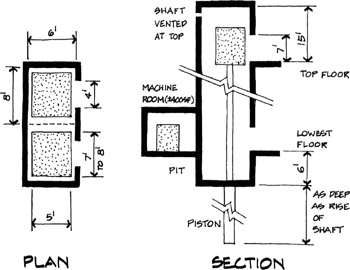
Hydraulic: The least expensive and slower type. They are moved up and down by a piston. This type is generally used in low-rise buildings (2 to 4 stories) in which it is not necessary to move large numbers of people quickly.

| Costs: | |
| Passenger elevators | $51,000 (50 fpm, 2000 lbs) to $64,000 (150 fpm, 3000 lbs) per shaft. 3 stops, 3 openings. Add: 50 fpm/stop = +$3500; 500 Ib/stop = +$3500; stop = +$5300; custom interior = +$5000. |
| Hydraulic freight elevators | $56,750 (50 fpm, 3000 lbs) to $86,100 (150 fpm, 6000 lbs). |
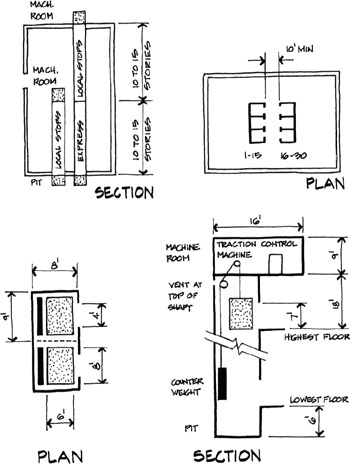
Traction Elevators: Traction elevators hang on a counter-weighted cable and are driven by a traction machine that pulls the cable up and down. They operate smoothly at fast speeds and have no limits. Typically, penthouse floor area equals twice the shaft area. A machine room is located either next to the penthouse or on any floor next to the shaft. The shafts, penthouse, pit, and landings are all major special components in the building and often comprise more than 10% of its costs.

| Costs: | |
| Passenger elevators/shaft | $66,000 (50 fpm, 2000 lbs) to $127,000 (300 fpm, 4000 lbs) for 6 stops, 6 openings. Add: stop = +$4000; 50 fpm/stop = +$2000; 500 lb/stop = +$2000; opening per stop = +$4500; custom... |