Electronic Devices and Amplifier Circuits with MATLAB Computing, Second Edition
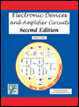
Emphasizing operational amplifiers and integrated devices used in digital circuits, this text presents a thorough discussion of state-of-the-art electronic devices.
 TABLE OF CONTENTS
 This is a long chapter devoted to bipolar junction transistors. The NPN and PNP transistors are defined and their application as amplifiers is well illustrated with numerous examples. The small and large signal equivalent circuits along with the h-parameter and T-equivalent circuits are presented, and the Ebers-Moll model is discussed in detail.
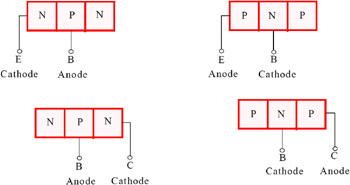
Transistors are three terminal devices that can be formed with the combination of two separate PN junction materials into one block as shown in Figure 3.1.

As shown in Figure 3.1, an NPN transistor is formed with two PN junctions with the P-type material at the center, whereas a PNP transistor is formed with two PN junctions with the N-type material at the center. The three terminals of a transistor, whether it is an NPN or PNP transistor, are identified as the emitter, the base, and the collector. Can a transistor be used just as a diode? The answer is yes, and Figure 3.2 shows several possible configurations and most integrated circuits employ transistors to operate as diodes.
Transistors are used either as amplifiers or more commonly as electronic switches. We will discuss these topics on the next section. Briefly, a typical NPN transistor will act as a closed switch when the voltage V BE between its base and emitter terminals is greater than 0.7 V but no greater than 5 V to avoid possible damage. The transistor...