Electronic Devices and Amplifier Circuits with MATLAB Computing, Second Edition
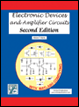
Emphasizing operational amplifiers and integrated devices used in digital circuits, this text presents a thorough discussion of state-of-the-art electronic devices.
 TABLE OF CONTENTS
 In the previous discussions we assumed that for every portion of the input signal there was an output from the amplifier. This is not always the case with all types of amplifiers. It may be desirable to have the transistor conducting for only a portion of the input signal The portion of the input for which there is an output determines the class of operation of the amplifier. There are four classes of amplifier operations. They are Class A, Class B, Class AB, and Class C.
Before discussing the different classes of amplifiers, we should remember that every amplifier has some unavoidable limitations on its performance. The most important that we need to be concerned about when choosing and using them are:
Limited bandwidth. For each amplifier there is an upper frequency beyond which it finds it impossible to amplify signals.
Noise. All electronic devices tend to add some random noise to the signals passing through them, hence degrading the SNR (signal to noise ratio). This, in turn, limits the accuracy of any measurement or communication.
Limited output voltage, current, and power levels. A given amplifier cannot output signals above a particular level; there is always a finite limit to the output signal size.
Distortion. The actual signal pattern will be altered due non-linearities in the amplifier. This also reduces the accuracy of measurements and communications.
Finite gain. A given...