Electronic Devices and Amplifier Circuits with MATLAB Computing, Second Edition
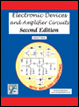
Emphasizing operational amplifiers and integrated devices used in digital circuits, this text presents a thorough discussion of state-of-the-art electronic devices.
 TABLE OF CONTENTS
 This chapter begins with an introduction to tuned amplifiers. We will examine the properties of various tuned amplifiers that find applications to telecommunications systems employing narrowband modulated signals. New tools for the analysis and design of tuned amplifiers are developed.
The amplifiers discussed in previous chapters are sufficient for most applications in which it is not required that the signals be transmitted over long distances. Thus they are adequate for audio amplifiers used in public address and home entertainment systems, servomechanisms, automatic pilots, electronic instruments, and a host of similar applications. However, when the signals must be transmitted over long distances, as between two cities or between a space vehicle and a ground station, effective use of the transmission medium requires the use of narrowband systems operating at high frequencies. Various systems of this kind operate throughout the frequency spectrum from 10 KHz to about 10 GHz although at the higher end of this range ordinary transistors are not used. For these higher frequencies it is necessary to use tuned amplifiers with RLC coupling to overcome the effects of parasitic capacitances and to provide a filtering operation in the form of frequency-selective amplification. In this section we will introduce the properties of various tuned amplifiers that find application in telecommunication systems.
A tuned amplifier is essentially a bandpass filter. [*] A passive bandpass filter is constructed with passive devices, i.e., resistors, inductors, and capacitors, and thus it provides no gain. For small signals,...