Electronic Devices and Amplifier Circuits with MATLAB Computing, Second Edition
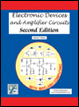
Emphasizing operational amplifiers and integrated devices used in digital circuits, this text presents a thorough discussion of state-of-the-art electronic devices.
 TABLE OF CONTENTS
 When a transistor is used as an amplifier, it is said to be operating in the active mode. Since a transistor is a 3-terminal device, there are three currents, the base current, denoted as i B, [*] the collector current, denoted as i c, and the emitter current, denoted as i E. They are shown in Figures 3.5 and 3.6.
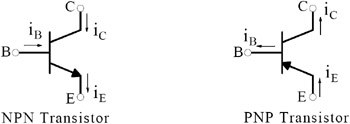
For any transistor, NPN or PNP, the three currents are related as

We recall from Chapter 2, equation (2.3), that  . In a transistor, n ?1, and the collector current is

where I r is the reverse (saturation) current, typically 10 ?12 A to 10 ?15 A as in junction diodes, V BE is the base-to-emitter voltage, and V T ?26 mV at T=300 K.
A very useful parameter in transistors is the common-emitter gain ?, a constant whose value typically ranges from 75 to 300. Its value is specified by the manufacturer. Please refer to Section 3.19. The base current i B is much smaller than the collector current i C and these two currents are related in terms of the constant ? as

and with (3.2) we obtain

From (3.1) and (3.3) we obtain

and with (3.2)

Another important parameter in transistors is the common-base current gain denoted as ? and...