Electronic Devices and Amplifier Circuits with MATLAB Computing, Second Edition
Emphasizing operational amplifiers and integrated devices used in digital circuits, this text presents a thorough discussion of state-of-the-art electronic devices.
 TABLE OF CONTENTS
 This appendix discusses three additional theorems that are especially useful in the simplification of circuits containing dependent sources. In our previous studies [*] we discussed the superposition principle and Thevenin s and Norton s theorems.
The substitution theorem states that if the voltage across a branch with nodes x and y of a network is v xy and the current through this branch is i xy, a different branch may be substituted in its place in the network provided that the voltage across the substitute branch is also v xy and the current through it is also i xy. The most common use of this theorem is to replace an impedance by a voltage or current source, or vice versa. The substitution theorem can best illustrated with the simple circuit and the substitute branches shown in Figure E.1.
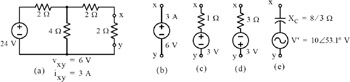
For the simple resistor circuit of Figure E.1(a) we find by series-parallel resistance combinations that v=6 V and i=3 A. According to the substitution theorem, the 2 ? resistor across terminals x and y can be replaced with a source with a 6 V source as shown in Figure E.1(b) and the rest of the network will be unaffected. The current in the branch will be 3 A as before.
Other substitutions are possible also. For instance, the substitute branch may consist of a resistance of 1 ? and a voltage source of 3 V...