Electronic Devices and Amplifier Circuits with MATLAB Computing, Second Edition
Emphasizing operational amplifiers and integrated devices used in digital circuits, this text presents a thorough discussion of state-of-the-art electronic devices.
 TABLE OF CONTENTS
 The fixed bias arrangement discussed in the previous section is thermally unstable. If the temperature of the transistor rises for any reason (due to a rise in ambient temperature or due to current flow through it), the collector current will increase. This increase in current also causes the DC quiescent point to move away from its desired position (level). This reaction to temperature is undesirable because it affects amplifier gain (the number of times of amplification) and could result in distortion, as we will see later in this chapter. A better method of biasing, known as selfbias is obtained by inserting the bias resistor directly between the base and collector, as shown in Figure 3.28.
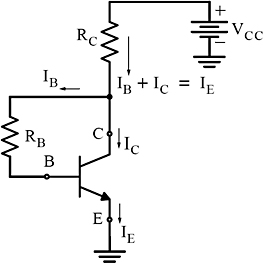
By tying the collector to the base in this manner, feedback voltage can be fed from the collector to the base to develop forward bias. Now, if an increase of temperature causes an increase in collector current, the collector voltage V c will fall because of the increase of voltage produced across the collector resistor R L. This drop in V c will be fed back to the base and will result in a decrease in the base current. The decrease in base current will oppose the original increase in collector current and tend to stabilize it. The exact opposite effect is produced when the collector current decreases. From Figure 3.28,
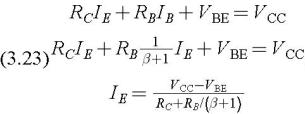
From (3.23) we see that to maintain the emitter current I