Electronic Devices and Amplifier Circuits with MATLAB Computing, Second Edition
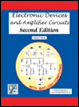
Emphasizing operational amplifiers and integrated devices used in digital circuits, this text presents a thorough discussion of state-of-the-art electronic devices.
 TABLE OF CONTENTS
 In our discussion on piece-wise linear models on the preceding section, the small voltage drop between base and emitter is small in comparison with the bias voltage and thus can be neglected. However, the base-to-emitter voltage cannot be neglected when only the increments of voltage and currents is considered. Also, when calculating increments of current and voltage, it is often necessary to account for the small effects of variations in collector voltage on both the input and output circuits. For these reasons the incremental model for the transistor provides a better approximation than the piece-wise linear approximation.
The base-to-emitter voltage v BE and the collector current i C are functions of the base current i B and collector-to-emitter voltage v CE. In other words,

and

If i B and v CE are changed in small increments, the resulting increment in v BE can be expressed as

and the increment in i C can be written as

The partial derivative in the first term of (3.64) has the dimensions of resistance and it is denoted as r n, and that in the second term is a dimensionless voltage ratio denoted as . It is also convenient to denote these derivatives in lower case letters with lower case subscripts. Then, (3.64) is expressed as

Likewise, the partial derivative in the first term of (3.65) is a dimensionless current ratio denoted as ?, and that in the second term...