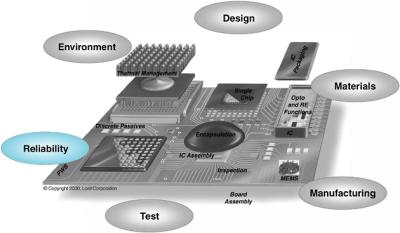
Fundamentals of Microsystems Packaging

Prof. Suresh K. Sitaraman
Georgia Institute of Technology
Prof. John H. L. Pang
Nanyang Technological University, Singapore

Introduce the need for design for reliability
List the main causes of reliability failures and relate to their mechanisms
Define and describe each of the failures and propose design guidelines against the failure
Every electronic product is designed to meet four criteria. These are performance, cost, size and reliability. Electrical designers typically design for performance and size, while manufacturing engineers typically design for cost. Reliability is not often designed for up-front, but rather tested either during the product qualification or after the product is manufactured. This is a very expensive and time-consuming approach. The better way is to design for reliability just like for performance, size and cost. This chapter introduces the key concepts for doing so.
When a product performs the functions for which it is designed, then that product is said to be reliable. When it does not, it is said to be unreliable. The purchaser of an automobile expects the automobile to start and run when the ignition is turned on. If it does, it is said to be reliable. Also, when maintained properly, the purchaser expects the automobile to start and run for several more years and several thousand kilometers. That is considered long-term reliability. Similarly, a personal computer is designed to last between five and seven years; an automotive controller is designed to last between...