Fundamentals of Microsystems Packaging

Dr. Pulugurtha Markondeya Raj
Georgia Institute of Technology
Prof. Johan Liu
Chalmers University of Technology, Sweden
Per hlckers
Olso University, Norway

Describe the diverse and crucial role of materials in microsystems packaging
Describe the most important material properties relevant to packaging
Discuss packaging processes for the IC and system-level packaging
Look at future materials, relevant issues and bottlenecks
Materials constitute the heart and soul of all microelectronic systems, because their properties dictate how efficiently their system-level performance, size, cost and reliability are met. This chapter reviews the role of materials in providing the system-level functions, and it translates these functions into specific electrical, mechanical, chemical and thermal properties. Finally, it describes both the thin- and thick-film processes by which these materials are processed into IC and system-level packages.
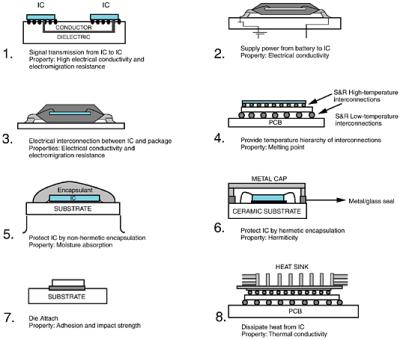
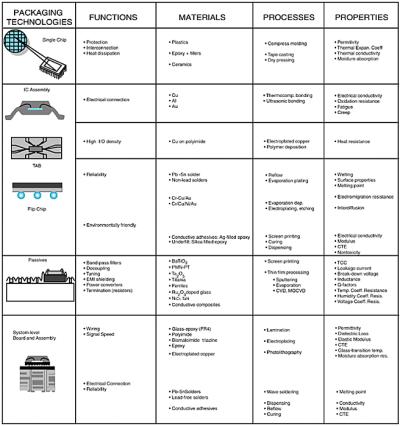
Materials provide several functions in microelectronic packaging. They transmit signals from IC to IC, supply power to ICs, provide interconnections to form the system-level hierarchy, mechanically and environmentally protect ICs, and dissipate heat. These functions are schematically depicted in Figure 18.1. The functions of the package dictate the required properties, based on which appropriate materials are chosen within the cost and processing constraints. A comprehensive list of packaging technologies, functions, properties, materials and processes are described in Figure 18.2.
Packaging of an integrated circuit (IC),...