Fundamentals of Signals and Systems

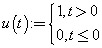
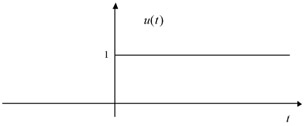
The continuous-time unit step function u( t), plotted in Figure 1.36, is defined as follows:
| (1.55) | |
Note that since u( t) is discontinuous at the origin, it cannot be formally differentiated. We will nonetheless define the derivative of the step signal later and give its interpretation.
One of the uses of the step signal is to apply it at the input of a system in order to characterize its behavior. The resulting output signal is called the step response of the system. Another use is to truncate some parts of a signal by multiplication with time-shifted unit step signals.
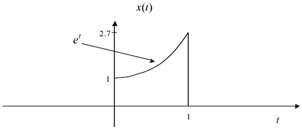
The finite-support signal x( t) shown in Figure 1.37 can be written as x( t) = e t [ u( t) - u( t -1)] or as x( t) = e tu( t) u( -t +1).
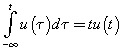
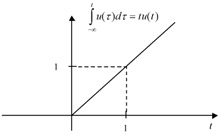
The running integral of u( t) is the unit ramp signal tu( t) starting at t = 0, as shown in Figure 1.38:
| (1.56) | |
Successive integrals of u( t) yield signals with increasing powers of t:
| (1.57) | |
The unit impulse ?( t), a generalized function that has infinite amplitude over...