Fundamentals of Signals and Systems

Chapter 5: The Continuous-Time Fourier Transform

LECTURE 15: DEFINITION AND PROPERTIES OF THE CONTINUOUS-TIME FOURIER TRANSFORM

The Fourier series is a frequency-domain representation of a continuous-time periodic signal. What about aperiodic signals? The concept of Fourier series can be extended to the Fourier transform, which applies to many aperiodic signals. For instance, all signals of finite energy have a Fourier transform, also called a spectrum.

As mentioned earlier, engineers often like to think of a signal as a spectrum whose energy is mostly contained in certain frequency bands. For instance, the Fourier transform of a human voice signal would show that most of the spectral contents of the signal are contained between 300 Hz and 3400 Hz. This is why the old telephone lines, seen here as linear time-invariant (LTI) systems that transmit continuous-time voice signals as voltage signals, were designed to have a flat frequency response over that band so as to maintain signal integrity.

FOURIER TRANSFORM AS THE LIMIT OF A FOURIER SERIES

In order to introduce the Fourier transform, we will use the specific example of a periodic rectangular signal, and we will let the period tend to infinity so as to have only the base period effectively remaining, that is, the part of the waveform around time t = 0. We will see that the Fourier transform in this particular case is nothing but the sinc envelope of the Fourier series coefficients.

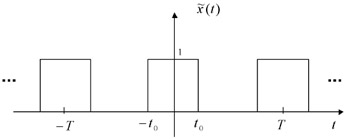
Consider the Fourier series representation of the rectangular wave shown in Figure 5.1.


Figure 5.1: Periodic rectangular...

UNLIMITED FREE
ACCESS
TO THE WORLD'S BEST IDEAS

SUBMIT
Already a GlobalSpec user? Log in.

This is embarrasing...

An error occurred while processing the form. Please try again in a few minutes.

Customize Your GlobalSpec Experience

Category: Spectrum Analyzers and Signal Analyzers
Finish!
Privacy Policy

This is embarrasing...

An error occurred while processing the form. Please try again in a few minutes.