Fundamentals of Signals and Systems

Chapter 16: Introduction to Communication Systems

LECTURE 63: AMPLITUDE MODULATION AND SYNCHRONOUS DEMODULATION

The field of telecommunications engineering has radically changed our lives by allowing us to communicate with other people from virtually any location on earth and even from space. Who could have imagined two hundred years ago that this could ever be possible? The study of communication systems is largely based on signals and systems theory. In particular, the time-domain multiplication property of Fourier transforms is used in amplitude modulation. This chapter is a brief introduction to the basic theory of modulation for signal transmission.

COMPLEX EXPONENTIAL AND SINUSOIDAL AMPLITUDE MODULATION

Recall the time-domain multiplication property for Fourier transforms: the multiplication of two signals results in the convolution of their spectra:

(16.1)

Amplitude modulation (AM) is based on this property. For example, consider the modulation system described by

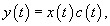
(16.2)

where the modulated signal y( t) is the product of the carrier signal c( t) and the modulating signal x( t), also called the message. The carrier signal can be a complex exponential or a sinusoid, or even a pulse train.

An important objective in modulation is to produce a signal whose frequency range is suitable for transmission over the communication channel to be used. In telephone systems, long-distance transmission is often accomplished over microwave (300 MHz to 300 GHz) or satellite links (300 MHz to 40 GHz), but most of the energy of a voice signal is in the range of 50 Hz to 5...

UNLIMITED FREE
ACCESS
TO THE WORLD'S BEST IDEAS

SUBMIT
Already a GlobalSpec user? Log in.

This is embarrasing...

An error occurred while processing the form. Please try again in a few minutes.

Customize Your GlobalSpec Experience

Category: Radio Transmitter ICs
Finish!
Privacy Policy

This is embarrasing...

An error occurred while processing the form. Please try again in a few minutes.