Fundamentals of Signals and Systems

LECTURE 2: SOME USEFUL SIGNALS

LECTURE 2: SOME USEFUL SIGNALS

Complex Exponential Signals

Complex exponential signals can also be defined both in continuous time and in discrete time. They have real and imaginary parts with sinusoidal behavior.

Continuous Time

The continuous-time complex exponential signal can be defined as follows:

(1.12)

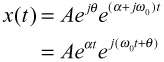
where C = Ae j?, A, ? ? ?, A > 0 is expressed in polar form, and a = ? + j ? 0, ?, ? 0 ? ? is expressed in rectangular form. Thus, we can write

(1.13)

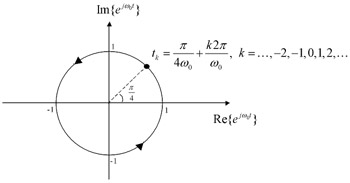
If we look at the second part of Equation 1.13, we can see that x( t) represents either a circular or a spiral trajectory in the complex plane, depending whether a is zero, negative, or positive. The term describes a unit circle centered at the origin counterclockwise in the complex plane as time varies from t =- ? to t = + ? , as shown in Figure 1.23 for the case ? = 0. The times t k indicated in the figure are the times when the complex point has a phase of ?/4 .


Figure 1.23: Trajectory described by the complex exponential.

Using Euler's relation, we obtain the signal in rectangular form:

(1.14)

where Re{ x( t)} = Ae ?t cos( ? 0 t + ?) and Im{ x( t)} = Ae ?t sin( ? 0

UNLIMITED FREE
ACCESS
TO THE WORLD'S BEST IDEAS

SUBMIT
Already a GlobalSpec user? Log in.

This is embarrasing...

An error occurred while processing the form. Please try again in a few minutes.

Customize Your GlobalSpec Experience

Category: IC Electronic Filters
Finish!
Privacy Policy

This is embarrasing...

An error occurred while processing the form. Please try again in a few minutes.