Fundamentals of Signals and Systems

EXERCISES

EXERCISES WITH SOLUTIONS

Exercise 1.1:

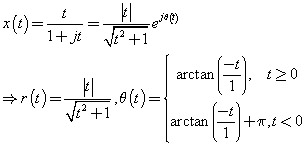
Write the following complex signals in polar form, that is, in the form x( t) = r( t) e j? ( t ), r( t), ?( t) ? ?, r( t) > 0 for continuous-time signals and x[ n] = r[ n] e j? [ n ], r[ n], ?[ n] ? ? , r[ n] > 0 for discrete-time signals.

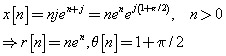
  1. x[ n] = nje n + j, n >0

Answers


Exercise 1.2:

Determine whether the following systems are: (1) memoryless, (2) time-invariant, (3) linear, (4) causal, or (5) BIBO stable. Justify your answers.

  1. y[ n] = x[1 - n]

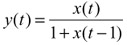
  1. y( t) = tx( t)

  1. y[ n] = x[ n- k]

Answers

  1. Memoryless? No. For example, the output y[0] = x[1] depends on a future value of the input.

  2. Time-invariant? No.


  3. Linear? Yes. Let y 1[ n]:= Sx 1[ n] = x 1[1 -n], y 2[ n]:= Sx 2[ n] = x 2[1- n].Then, the output of the system with x[ n] := ? x 1 [ n] + ?x 2 [ n] is...

UNLIMITED FREE
ACCESS
TO THE WORLD'S BEST IDEAS

SUBMIT
Already a GlobalSpec user? Log in.

This is embarrasing...

An error occurred while processing the form. Please try again in a few minutes.

Customize Your GlobalSpec Experience

Category: Thermocouple Elements
Finish!
Privacy Policy

This is embarrasing...

An error occurred while processing the form. Please try again in a few minutes.