Fundamentals of Signals and Systems

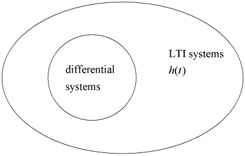
Differential and difference linear time-invariant (LTI) systems constitute an extremely important class of systems in engineering. They are used in circuit analysis, filter design, controller design, process modeling, and in many other applications. We will review the classical solution approach for such systems. Figure 3.1 shows that differential systems form a subset of the set of continuous-time LTI systems. A consequence of this set diagram is that any differential system has an impulse response. The same is true for difference systems. We will show techniques to compute their impulse response.
Differential systems form the class of systems for which the input and output signals are related implicitly through a linear, constant coefficient ordinary differential equation. Note that partial differential equations, such as the heat equation, are excluded here, as they represent distributed-parameter or infinite-dimensional systems, which are out of the scope of this book.
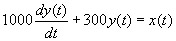
Consider a first-order differential equation relating the input x( t) to the output y( t):
| (3.1) | |
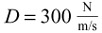
This equation could represent the evolution of the velocity y( t) in meters per second of a car of mass m = 1000 kg, subjected to an aerodynamic drag force proportional to its speed Dy( t), where
and in which x( t) is the tractive force in...