Fundamentals of Signals and Systems

All of the following system properties apply equally to continuous-time and discrete-time systems.
A system S is linear if it has the additivity property and the homogeneity property. Let y 1 := Sx 1 and y 2 := Sx 2.
| (1.80) | |
That is, the response of S to the combined signal x 1 + x 2 is the sum of the individual responses y 1 and y 2.
| (1.81) | |
Homogeneity means that the response of S to the scaled signal ax 1 is a times the response y 1 = Sx 1. An important consequence is that the response of a linear system to the 0 signal is the 0 signal. Thus, the system y( t) = 2 x( t) + 3 is nonlinear because for x( t) = 0, we obtain y( t) = 3.
The linearity property (additivity and homogeneity combined) is summarized in the important Principle of Superposition: the response to a linear combination of input signals is the same linear combination of the corresponding output signals.
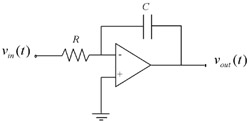
Consider the ideal operational-amplifier (op-amp) integrator circuit shown in Figure 1.52.
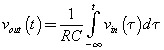
The output voltage of this circuit is given by a running integral of the input voltage:
| (1.82) | |
If v in( t) = av