Fundamentals of Signals and Systems

Chapter 13: The z-Transform

LECTURE 47: DEFINITION AND CONVERGENCE OF THE Z-TRANSFORM

Recall that the Laplace transform was introduced as being a more general tool to represent continuous-time signals than the Fourier transform. For example, the latter could not be used for signals tending to infinity. In discrete time, the z-transform defined as a Laurent series plays the role of the Laplace transform in that it can be used to analyze signals going to infinity as long as an appropriate region of convergence (ROC) is determined for the Laurent series. In this chapter, we will define the z-transform and study its properties. We will see that the z-transform of the impulse response of a discrete-time linear time-invariant (DLTI) system, called the transfer function, together with its region of convergence, completely define the system. In particular, the transfer function evaluated on the unit circle in the complex plane is nothing but the frequency response of the system.

DEVELOPMENT OF THE TWO-SIDED Z-TRANSFORM

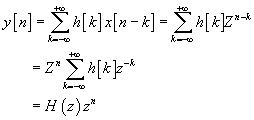
The response of a DLTI system to a complex exponential input z n is the same complex exponential, with only a change in (complex) amplitude: z n * h[ n] = H( z) z n, as shown below. The complex amplitude factor is in general a function of the complex variable z.

(13.1)

The system's response has the form y[ n] = H( z) z n, where H( z) = h[ n]

UNLIMITED FREE
ACCESS
TO THE WORLD'S BEST IDEAS

SUBMIT
Already a GlobalSpec user? Log in.

This is embarrasing...

An error occurred while processing the form. Please try again in a few minutes.

Customize Your GlobalSpec Experience

Category: IC Electronic Filters
Finish!
Privacy Policy

This is embarrasing...

An error occurred while processing the form. Please try again in a few minutes.