Fundamentals of Signals and Systems

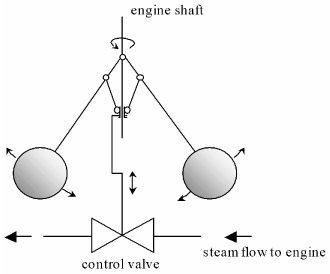
The use of feedback dates back more than two thousand years to the Greeks and the Arabs, who invented the water clock based on a water level float regulator. Closer to us, and marking the beginning of the industrial revolution in 1769, was the invention by James Watt of the Watt governor, shown in Figure 11.1. The Watt governor was used to regulate automatically the speed of steam engines by feedback. This device measures the angular velocity of the engine shaft with the help of the centrifugal force acting on two spinning masses hinged at the top of the engine shaft. The centrifugal force is counteracted by the gravitational force. When in balance at a constant engine speed, the vertical positions of the masses are given by a function of the shaft angular velocity, and their vertical displacement is linked to a valve controlling the flow of steam to the engine. Thus, the Watt governor is a mechanical implementation of proportional control of the engine shaft velocity.
It has only been about 70 years since engineers and mathematicians developed the mathematical tools to analyze and design feedback control systems. However, feedback control has proven to be an enabling technology in many industries and it has enjoyed a lot of interest in research and development circles. This chapter only gives a brief introduction to linear time-invariant (LTI) feedback control systems and studies them with the...