Fundamentals of Signals and Systems

Chapter 6: The Laplace Transform

LECTURE 20: DEFINITION OF THE LAPLACE TRANSFORM

So far, we have studied the Fourier series and the Fourier transform for the analysis of periodic and aperiodic signals, and linear time-invariant (LTI) systems. These tools are useful because they allow us to analyze continuous-time signals and systems in the frequency domain. In particular, signals can be represented as linear combinations of periodic complex exponentials, which are eigenfunctions of LTI systems, but if we replace j ? with the more general complex variable s in the Fourier transform equations, we obtain the Laplace transform, a generalization of the Fourier transform.

The Fourier transform was defined only for signals that taper off at infinity, that is, signals of finite energy or signals that are absolutely integrable. On the other hand, the Laplace transform of an unbounded signal or of an unstable impulse response can be defined. The Laplace transform can also be used to analyze differential LTI systems with nonzero initial conditions.

DEFINITION OF THE TWO-SIDED LAPLACE TRANSFORM

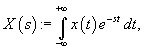
The two-sided Laplace transform of x( t) is defined as follows:

(6.1)

where s is a complex variable. Notice that the Fourier transform is given by the same equation, but with s = j ?.

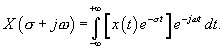
Let the complex variable be written as s = ? + j ?. Then the Laplace transform can be interpreted as the Fourier transform of the signal x( t) e - ?t:

(6.2)

Given x(

UNLIMITED FREE
ACCESS
TO THE WORLD'S BEST IDEAS

SUBMIT
Already a GlobalSpec user? Log in.

This is embarrasing...

An error occurred while processing the form. Please try again in a few minutes.

Customize Your GlobalSpec Experience

Category: IC Electronic Filters
Finish!
Privacy Policy

This is embarrasing...

An error occurred while processing the form. Please try again in a few minutes.