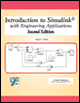
Introduction to Simulink with Engineering Applicatioins, Second Edition
20.2: The Zero-Order Hold and First-Order Hold as Reconstructors

20.2 The Zero-Order Hold and First-Order Hold as Reconstructors

Suppose that a continuous-time signal x(t) is bandlimited with bandwidth B, and its Fourier transform X( ?) is zero for ? > B. The Sampling Theorem states that if the sampling frequency ? s is equal or greater than 2B, the signal x(t) can be recover entirely from the sampled signal x s(t) by applying x s(t) to an ideal lowpass filter with bandwidth B. Another method for recovering the continuous-time signal x(t) from the sampled signal x s(t) is to use a holding circuit that holds the value of the sampled signal at time nT until it receives the next value at time nT + T. A Zero-Order Hold circuit behaves like a low-pass filter and thus can be used as a holding circuit to recover the continuous-time signal x(t) from the sampled signal x s(t).

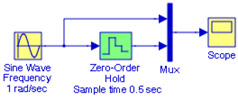
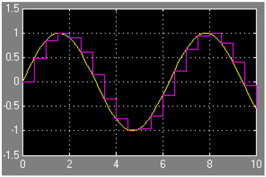
The model in Figure 20.37 shows the output of a Zero-Order Hold block specified at a low sampling frequency, and Figure 20.38 shows the input and output waveforms.


Figure 20.37: Model producing a piecewise constant waveform when the sampling frequency is low

Figure 20.38: Input and output waveforms for the model in Figure 20.37

Whereas the Zero-Order Hold circuit generates a continuous input signal u(t) by holding each sample value u[k] constant over one sample period, a First-Order Hold circuit uses linear interpolation between samples as shown by the model of Figure 20.39 and...

UNLIMITED FREE
ACCESS
TO THE WORLD'S BEST IDEAS

SUBMIT
Already a GlobalSpec user? Log in.

This is embarrasing...

An error occurred while processing the form. Please try again in a few minutes.

Customize Your GlobalSpec Experience

Category: Sample-and-Hold Amplifiers
Finish!
Privacy Policy

This is embarrasing...

An error occurred while processing the form. Please try again in a few minutes.