Introduction to Simulink with Engineering Applicatioins, Second Edition
In this section we will create three models for mechanical systems. Subsection 20.5.1 presents a Block-Spring-Dashpot system, Subsection 20.5.2 presents a system with two mass blocks and two springs, and Subsection 20.5.3 is a simple mechanical accelerometer system
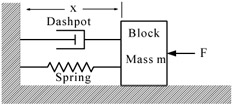
Figure 20.59 shows a system consisting of a block, a dashpot, and a spring. It is shown in feedback and control systems textbooks that this system is described by the second-order differential equation
| (20.46) | |
where m represents the mass of the block, p is a positive constant of proportionality of the force that the dashpot exerts on the block, and k is also a positive constant of proportionality of the force that the spring exerts on the block, known as Hooke's law.
The mass of the dashpot and the mass of the spring are small and are neglected. Friction is also neglected. For the system of Figure 20.59, the input is the applied force F and the output is the change in distance x.
Let us express the differential equation of (20.46) with numerical coefficients as
| (20.47) | |
where u 0(t) is the unit step function, and the initial conditions are x(0) = 4, and dx/dt = 0. For convenience, we denote these are denoted as x1 0 and x2 0 respectively.
For the solution of (20.47) we will use the State-Space block found in...