Introduction to Simulink with Engineering Applicatioins, Second Edition
20.7: Models for Electrical Systems

20.7 Models for Electrical Systems

In this section we will draw two models for mechanical systems. Subsection 20.7.1 presents an electric circuit whose output voltage is determined by application of Thevenin's theorem, and Subsection 20.7.2 presents an electric circuit to be analyzed by application of the Superposition Principle.

20.7.1 Model for an Electric Circuit in Phasor [14] Form

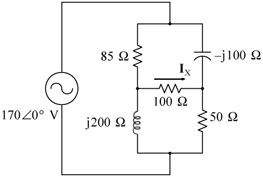
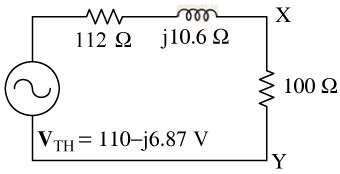
By application of Thevenin's theorem, the electric circuit of Figure 20.76 can be simplified [15] to that shown in Figure 20.77.


Figure 20.76: Electric circuit to be replaced by its Thevenin equivalent

Figure 20.77: The circuit of Figure 20.60 replaced by its Thevenin equivalent

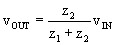
Next, we let V IN = V TH, V OUT = V XY, Z 1 = 112+j10, and Z 2 = 100. Application of the voltage division expression yields

(20.60)

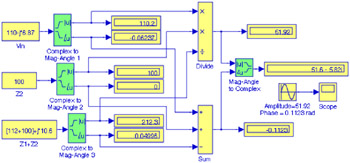
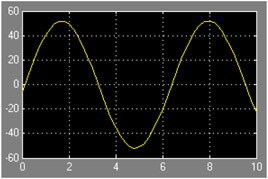
Now, we use the model in Figure 20.78 to convert all quantities from the rectangular to the polar form, perform the addition and multiplication operations, display the output voltage in both polar and rectangular forms, and show the output voltage on a Scope block in Figure 20.79. The Simulink blocks used for the conversions are in the Math Operations library. We can also use the conversion blocks presented in Chapter 19, Simulink Extras.


Figure 20.78: Model for the computation and display of the output voltage for the circuit in Figure 20.77

Figure 20.79: Waveform for the output voltage of model in Figure 20.78

20.7.2 Model for the Application of the...

UNLIMITED FREE
ACCESS
TO THE WORLD'S BEST IDEAS

SUBMIT
Already a GlobalSpec user? Log in.

This is embarrasing...

An error occurred while processing the form. Please try again in a few minutes.

Customize Your GlobalSpec Experience

Category: Power Supplies
Finish!
Privacy Policy

This is embarrasing...

An error occurred while processing the form. Please try again in a few minutes.