Introduction to Simulink with Engineering Applicatioins, Second Edition
A given transfer function H(z) of a digital filter can be realized in several forms, the most common being the Direct Form I, Direct Form II, Cascade (Series), and Parallel. These are described in Subsections 20.3.1 through 20.3.4 below. Similar demo models can be displayed as indicated in these subsections.
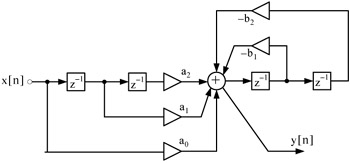
The Direct Form I Realization of a second-order digital filter is shown in Figure 20.43.
At the summing junction of Figure 20.43 we obtain
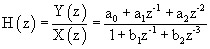
and thus the transfer function of the Direct Form I Realization of the second-order digital filter of Figure 20.43 is
| (20.37) | |
A disadvantage of a Direct Form I Realization digital filter is that it requires 2k registers where k represents the order of the filter. We observe that the second-order (k = 2) digital filter of Figure 20.27 requires 4 delay (register) elements denoted as z -1. However, this form of realization has the advantage that there is no possibility of internal filter overflow. [9]
Figure 20.28 shows the Direct Form-II [10] Realization of a second-order digital filter. The Sim-ulink Transfer Fcn Direct Form II block implements the transfer function of this filter.
The transfer function for the Direct Form-II second-order digital filter of Figure 20.44 is the same as for a Direct...